



An AI data centre is a specialised facility purpose-built to train and run artificial intelligence models, relying on GPU clusters, liquid cooling systems, and high-bandwidth networking that set it apart from traditional computing infrastructure.
These facilities have become the backbone of modern AI development, powering everything from chatbots to image generators and LLMs.
AI data centres vs traditional data centres
The differences go far beyond swapping out processors. Traditional data centres were designed for predictable, distributed workloads like web hosting, email, and databases. AI data centres face fundamentally different demands that touch every aspect of facility design.
| Feature | Traditional data centre | AI data centre |
| Primary compute | CPUs | GPUs and accelerators |
| Power density per rack | 5-15 kW | 40-100+ kW |
| Cooling requirements | Air cooling sufficient | Chillers and Liquid cooling often required |
| Workload type | General enterprise apps | Model training and inference |
| Network architecture | Standard Ethernet | High-bandwidth, low-latency fabric |
A single AI training cluster can consume as much power as a small town. This concentration of compute creates thermal and electrical challenges that traditional facilities simply were not built to handle, which is why purpose-built AI data centres have become necessary & why data centre chillers are important.
Core infrastructure inside an AI data centre
GPU clusters and high-performance computing
GPUs form the computational backbone of AI data centres. Originally designed for rendering video games, graphics processing units excel at performing thousands of calculations simultaneously—which happens to be exactly what AI training requires.
A single GPU cluster might contain thousands of individual processors working together on one training job. High-performance computing, or HPC, orchestrates this parallel processing by coordinating the flow of data and calculations across the entire system. Without this coordination, the processors would spend more time waiting for each other than actually computing.
High-bandwidth networking fabric
AI workloads demand constant, rapid data exchange between processors. When training a large model, GPUs continuously share intermediate results with each other, so any network bottleneck slows everything down.
Advanced storage architecture
Training datasets can be enormous—sometimes petabytes of text, images, or video. All of this data flows to GPUs continuously during training, so storage systems cannot create bottlenecks.
Rack power density & cooling
Here is where AI data centres diverge most dramatically from their predecessors. A rack of AI accelerators generates so much heat that air cooling simply cannot keep up, no matter how many fans you add.
As AI workloads push rack power densities higher, data centre chillers have become essential to data centre cooling. Modern chiller systems efficiently remove heat from high-density environments, helping operators maintain stable temperatures and improve energy efficiency – even at power densities far beyond those of traditional data centres
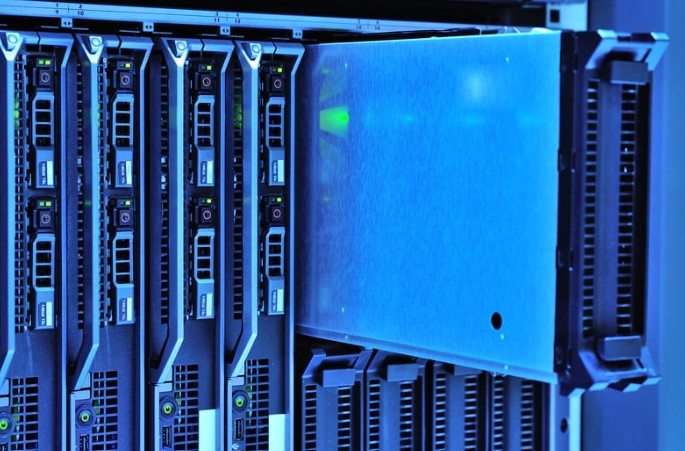
Types of AI data centre deployment models
Hyperscale AI data centres
Hyperscale facilities are the massive campuses operated by cloud providers and technology giants. A single hyperscale campus might house hundreds of thousands of GPUs, serving global AI services and training the largest foundation models. The scale allows for efficiency gains that smaller facilities cannot match.
Colocation AI data centres
Colocation allows organisations to deploy their own GPU hardware in a third-party facility. The colocation provider supplies power, cooling, and physical security, while the customer owns and operates the computer equipment. This model offers a middle ground between building from scratch and renting cloud capacity.
On-premises enterprise AI data centres
Some organisations build private AI facilities for data sovereignty, regulatory compliance, or proprietary model development. This approach offers maximum control but requires significant capital investment and operational expertise that many organisations lack.
Edge AI data centres
Edge computing brings AI inference closer to end users. Rather than sending requests across the internet to a distant hyperscale facility, edge data centres process requests locally. This reduces latency for applications like autonomous vehicles, real-time video analysis, or industrial automation where milliseconds matter.
Who operates the largest AI data centres
The AI data centre landscape is dominated by a few categories of operators, each with different motivations and business models:
- Hyperscale cloud providers: Companies offering AI compute as a service to enterprises and developers who want GPU access without building their own facilities
- Technology conglomerates: Firms training proprietary foundation models for their own products, from search engines to productivity software
- AI infrastructure specialists: Operators focused exclusively on GPU hosting and AI workloads, often serving AI startups and research institutions
- Sovereign and government-backed facilities: National AI initiatives building domestic compute capacity as a strategic priority
Whether you are a hyperscale, cloud provider, enterprise or emerging AI company, ICS Cool Energy provides reliable data centre chiller for hire to keep your operations running efficiently
Power consumption and energy sourcing for AI data centres
Renewable power purchase agreements
Power purchase agreements, or PPAs, are long-term contracts to buy electricity directly from renewable generators. AI data centre operators use PPAs to secure clean energy at predictable prices while supporting new renewable development. A PPA might lock in solar or wind power for 10 to 20 years, providing certainty for both the data centre and the energy developer.
Small modular reactors and nuclear power
Nuclear power offers reliable baseload generation independent of weather conditions. Small modular reactors, or SMRs, are compact nuclear plants that can be factory-built and deployed more quickly than traditional reactors. Several AI data centre operators have announced interest in SMRs as a way to secure carbon-free power without depending on grid availability.
On-site generation and grid constraints
Electrical grid limitations are delaying projects worldwide. Some operators are exploring on-site generation using natural gas turbines, fuel cells, or dedicated renewable installations to bypass grid bottlenecks entirely. This approach adds complexity but can shave years off project timelines in grid-constrained regions.
Environmental footprint and sustainability of AI data centres
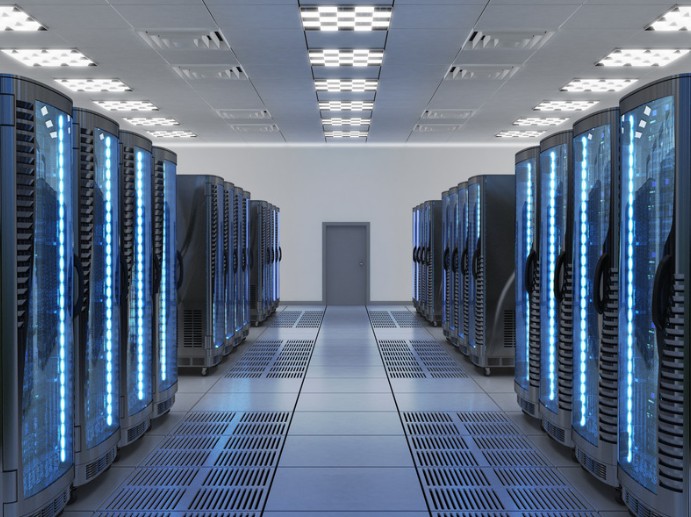
The environmental impact of AI data centres extends well beyond electricity consumption:
- Carbon emissions: The energy source determines carbon intensity—a facility powered by renewables has a very different footprint than one running on fossil fuels
- Water consumption: Cooling towers and evaporative systems can consume millions of gallons daily, which strains local freshwater supplies in some regions
- E-waste: GPU refresh cycles create hardware disposal challenges as older accelerators are replaced every few years
Sustainability initiatives: Heat recapture for district heating, renewable sourcing, and efficiency improvements are becoming standard practice among major operators
The future of AI data centres
Gigawatt-scale AI campuses
The trend toward consolidation continues. Gigawatt-scale facilities, which consume as much power as a large city, are moving from concept to construction. Concentrating compute in purpose-built locations with dedicated power infrastructure allows for efficiencies that distributed facilities cannot achieve.
AI factories and sovereign AI
The term “AI factory” captures an emerging model where facilities are designed specifically to produce trained models as their output. Meanwhile, sovereign AI initiatives see nations building domestic compute capacity for strategic independence. Countries increasingly view AI infrastructure as critical national capability, similar to energy or telecommunications.
Orbital and space-based AI data centres
Perhaps surprisingly, space-based AI compute is moving beyond science fiction. Natural cooling in the vacuum of space, uninterrupted solar power, and freedom from terrestrial grid constraints make orbital data centres an intriguing long-term possibility. Several companies are actively developing prototypes, though commercial deployment remains years away.
FAQs about AI data centres
Why do AI data centres consume so much water?
Cooling systems, particularly evaporative cooling towers, use water to dissipate heat. The water evaporates, carrying heat away from the facility. Consumption depends heavily on climate, cooling technology choices, and facility design. Some newer facilities use closed-loop systems that dramatically reduce water use by recirculating coolant rather than evaporating it.
Can existing data centres be retrofitted for AI workloads?
Some facilities can be upgraded with enhanced power distribution, liquid cooling, and high-bandwidth networking. However, retrofitting has limits. Buildings designed for 10 kW racks often cannot economically support 100 kW racks because the electrical and cooling infrastructure would require complete replacement. Purpose-built AI data centres typically offer better efficiency for large-scale deployments.
What does PUE mean for AI data centres?
Power Usage Effectiveness measures how efficiently a data centre uses energy by comparing total facility power to IT equipment power. A PUE of 1.0 would mean all power goes to computing, while a PUE of 1.5 means 50% overhead for cooling and other infrastructure. Well-designed AI data centres often achieve PUEs between 1.1 and 1.3, though liquid cooling can push this even lower.